
Before you complete your project workflow, you will need to make sure the right segments get stored for future reuse. Deciding which segments meet the quality for future reuse is very often the responsibility of a revisor or the manager of the project. That is why very often these are the ones responsible for the last step in the project workflow.
During that step, segments will be last updated before merged into the master memory, so that translations can be reused in future projects.
Read below to know what are some of the features and possible scenarios you may encounter and how to handle them
Use the segment status for consistency reasons
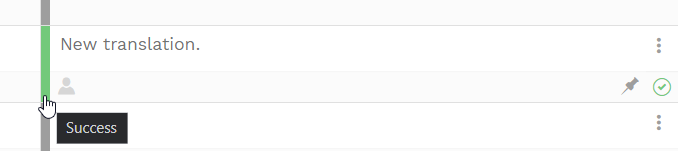
Before the job is set as completed, make sure you set the status of each segment to success (green color), so that the segments are merged into the destination resource accordingly. Moreover, it is necessary if you decide to leave some of the segments in the target language empty. Segments in green status will also qualify better if two matches with the same % are proposed by the system.
In general, it is always a good practice to confirm that the content of each segment is validated, regardless of the warning and info messages displayed in the tool.
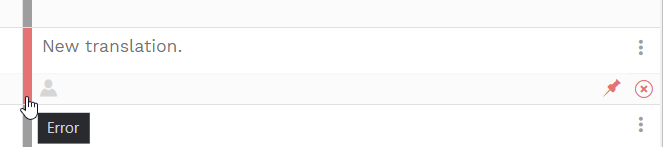
If you want to exclude some segments from being consolidated, you can mark them with a red status or red bookmark, which means that you only need them in the current translation but not for future projects. Segments that have the same text in source and target fields are also handled with a specific option. Learn more about this scenario here.
As an alternative to marking individual segments as red, you can instruct the system to automatically skip all segments left in neutral (grey) status during consolidation. This is useful when your workflow treats unreviewed segments as "not ready for reuse" and you want the consolidation to include only segments that have been positively confirmed (green). The option is a checkbox named "Exclude texts in neutral status" in the consolidation settings.
In practice, you have two complementary strategies:
-
Explicit exclusion: mark specific segments with red status or a red bookmark.
-
Implicit exclusion: enable the neutral-status filter to consolidate only green segments.
Decide which workflow step is responsible for readiness
If your platform has segment status per job enabled — a global setting your administrators turn on by contacting Wordbee, which then applies across all projects (see How linguists track their own progress per job) — you can give one workflow step direct control over the status that consolidation reads.
Marking segments green or red is usually the job of one specific step, often the final revision or review. To make that step decide readiness as the work happens:
-
Open the project and go to the Workflow & Suppliers tab.
-
Edit the step that signs off content for reuse.
-
Select Save segment status to the global segment status.
-
Save the workflow.

From then on, in any job built on that step, every status a linguist or a QA check sets is saved straight to the project's global status: green to confirm the content is ready for reuse, red or neutral to keep it out of consolidation. The step becomes the place where content is signed off, and segments are already correctly marked by the time the workflow consolidates. A job on such a step keeps no separate status of its own.
Use it with care: the step's status overwrites the project's global status, including a red set by a project-level QA check, so enable it only on the step you trust to decide readiness.
Once the job is completed, the consolidation takes place
If you are merging segments into an existing resource, you may be updating existing translations or creating additional entries for new languages in the database. Although undoing the consolidation of segments removes the merged texts from the resources, sometimes it won't be possible to retrieve all previous properties attached to the segment right away. Be careful when updating your segments and make sure that your whole team aligns to the same consolidation strategy.