
Wordbee Translator keeps your platform fast and your storage under control by moving old projects aside in stages. Completed projects get the Archived status. Archived and canceled projects are offloaded to cold storage. Projects that have not been used for the retention period of your subscription plan are permanently deleted. Your platform administrators are warned by email before any deletion, and a zip file of each deleted project stays available for download for at least 30 days.
This article explains each stage and what you can do to keep or recover your project data.
The project lifecycle at a glance
A project goes through these stages. Only Archived is a project status. The other stages describe what happens to the project's data.
|
Stage |
Where the data is |
How the project gets here |
How to go back |
|---|---|---|---|
|
Active |
Online. |
Every project starts here. |
Not applicable. |
|
Archived |
Online. Only the project status changes. |
You set the Archived status, or Wordbee sets it automatically some time after the project is completed. |
Change the status. |
|
Offloaded |
The project stays in your project list. Its files and translations are moved to cold storage as a zip file. |
You click Offload data, or Wordbee offloads archived and canceled projects automatically. |
Restore the project. |
|
Scheduled for deletion |
No change. Your administrators receive warning emails. |
The project is not used for the retention period of your plan. |
Use the project before the date in the first warning. |
|
Deleted |
The project is removed from the platform. Its zip file stays on the Archived Projects page. |
The day after the date in the first warning. |
Not possible. Download the zip file. |
|
Zip file removed |
Nothing is left. |
At least 30 days after the deletion. |
Not possible. |
Archiving and offloading projects
Before you offload a project
Once a project is offloaded, its files and translations are no longer online. Before that happens, make sure you keep what you still need:
-
Consolidate the project memory into a master memory. Otherwise, the translations in that project can't be reused in other projects once it is offloaded.
-
Make sure the files and deliverables are available in the related order. When the client portal is enabled, this is where your client finds the translations.
Both steps can be part of your regular project management, either automated or run manually. See Consolidation of Project Memories to Master and Workflow template (Automation options for orders).
Automatic archiving and offloading
Wordbee archives and offloads projects automatically at regular intervals. The periods depend on your subscription plan. You can find them on the License and Usage page, under File Storage.

These rules apply:
-
Archiving: a project in Completed status gets the Archived status once it has been completed for longer than the archiving period of your plan (from one month to one year).
-
Offloading: a project in Archived or Canceled status is offloaded once it has had that status for longer than the offloading period of your plan (from one week to one month).
-
Changing the status of an archived or canceled project, for example reopening it, stops the automatic offloading.
For questions about the periods of your plan, contact the Wordbee team.
Offloading a project manually
Administrators can offload a single project at any time.
Follow these steps to offload a project:
-
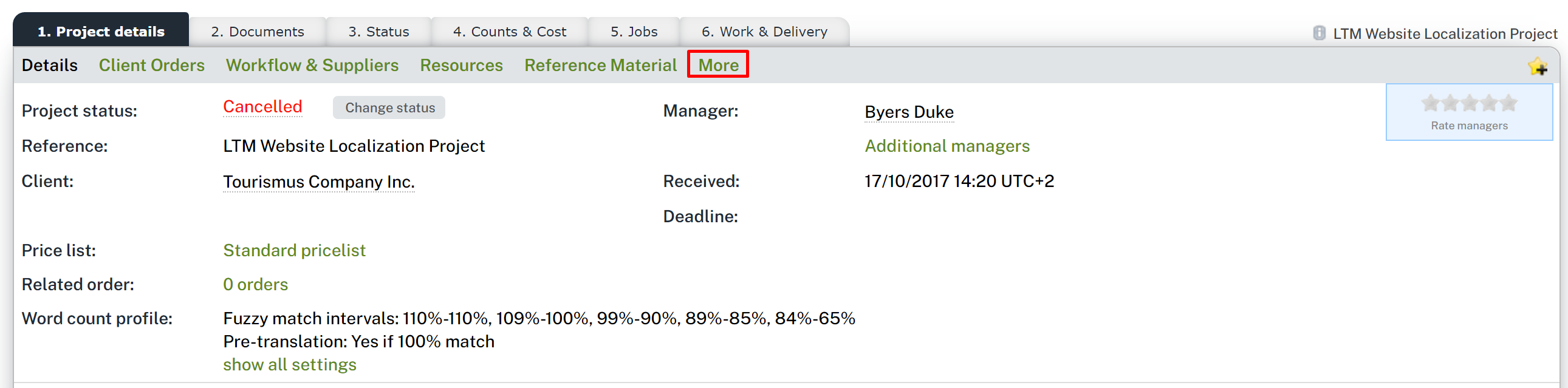
Open the Project details page.
-
In the More section, go to Project archival.
-
Click Offload data.
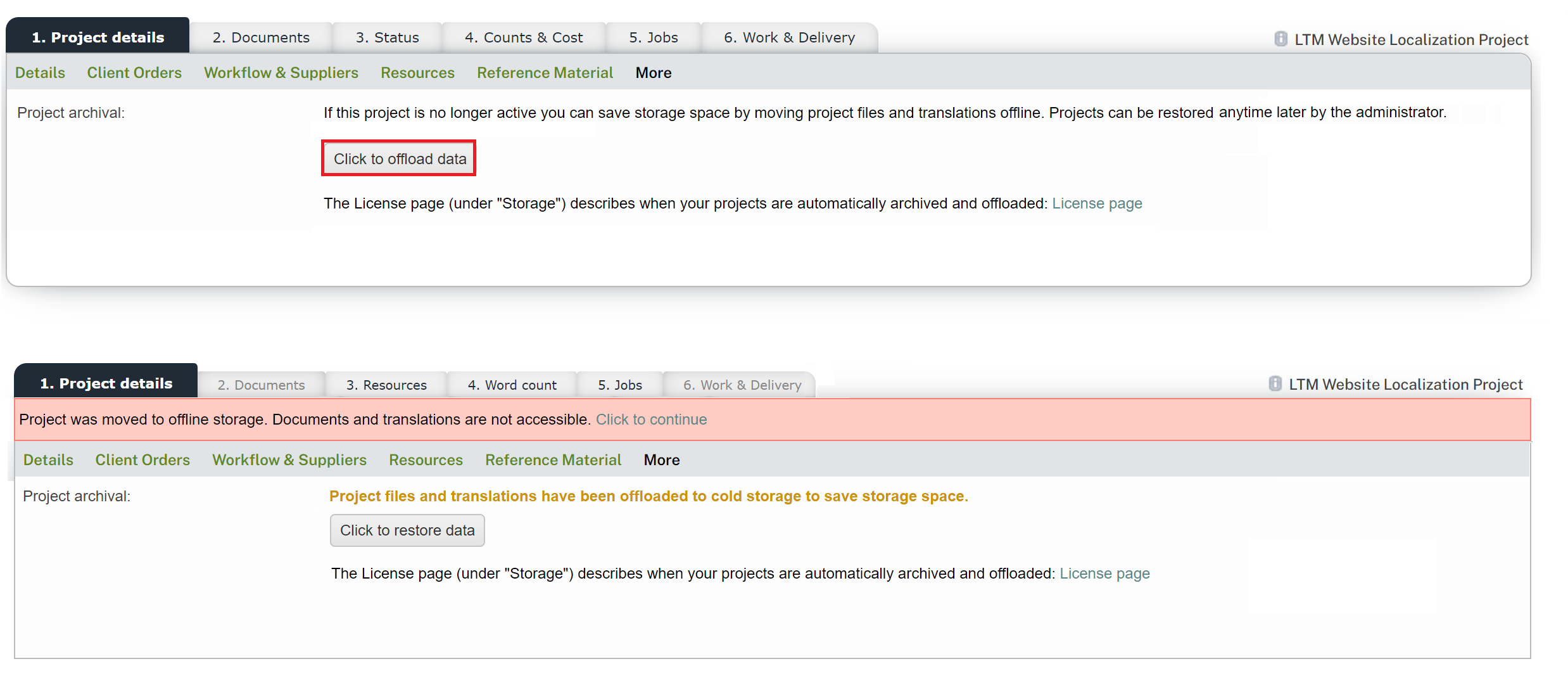
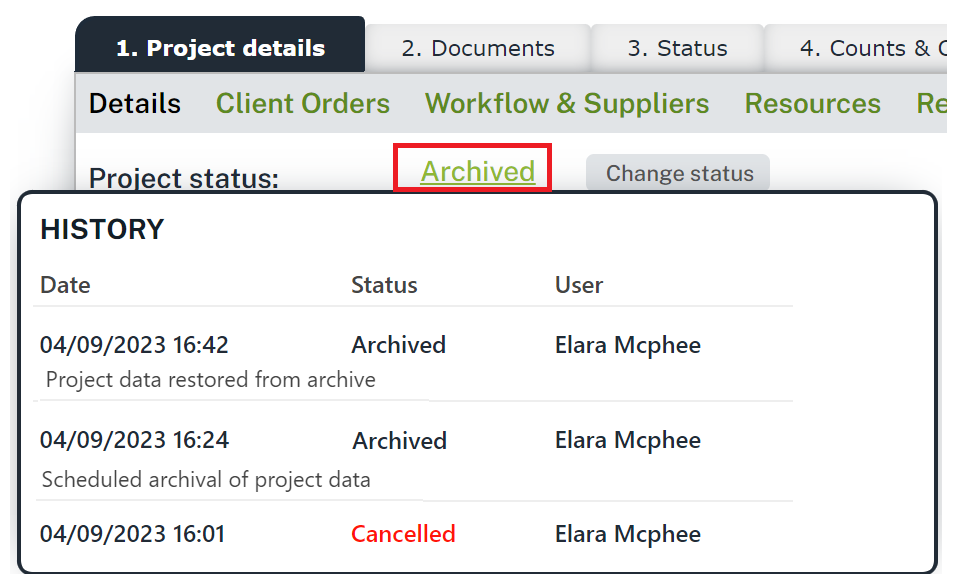
After offloading, the project's files are no longer available online, but most project sections stay accessible. Offloading and restoring are recorded in the project's status history.
Finding offloaded projects
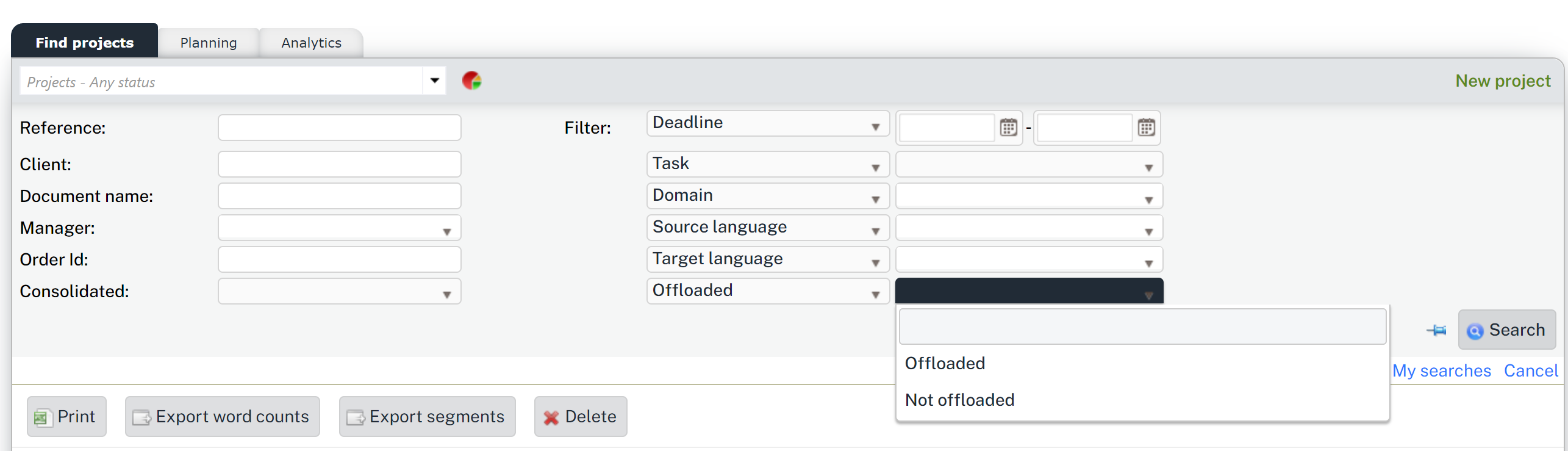
Use the filters on the project list to see which projects are offloaded and which are online. The same filters help you find files in a project, whether it is offloaded or not.
Restoring an offloaded project
Follow these steps to bring an offloaded project back online:
-
Open the Project details page.
-
Open the More section, or click the Click to continue link in the red banner.
-
Click Click to restore data.
The project's files and deliverables are available again.
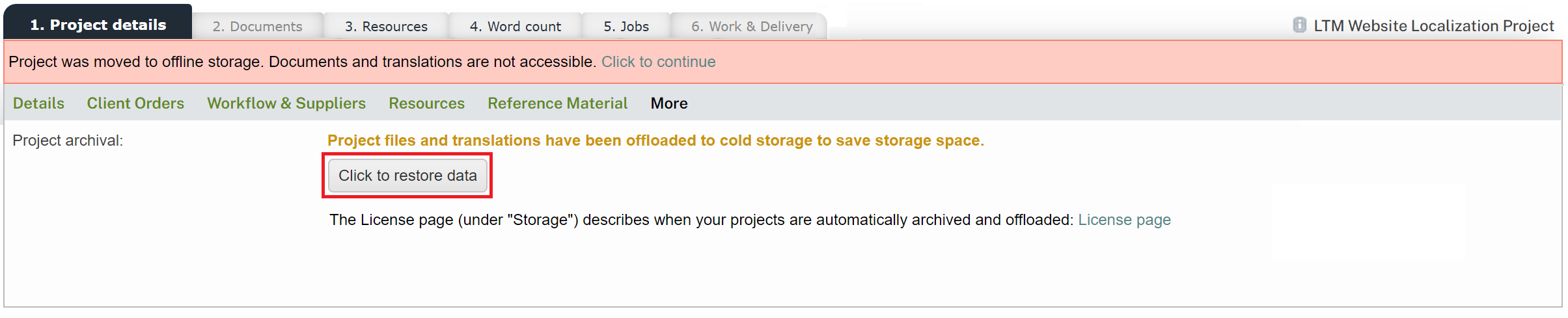
Restoring a project counts as activity: it restarts the project's data retention period.
Data retention
Wordbee permanently deletes projects that have not been used for the retention period of your subscription plan. The period is counted from the project's last used date. Offloaded projects are included: offloading a project does not stop its retention period.
Retention periods
|
Plan |
Retention period |
|---|---|
|
Freelance, Essential, Smart |
2 years |
|
Infinity |
3 years |
|
Enterprise |
Custom (as configured for your platform) |
What counts as activity
These actions update a project's last used date and restart its retention period:
-
Marking a file online or offline, or adding revised files
-
Adding or changing a job
-
Adding or changing an invoice
-
Creating or changing an order linked to the project
-
Changing the project status (except changing it to Archived)
-
Restoring the project from cold storage
-
Flex transactions
-
Beebox transactions
-
CMS integration events
Opening or viewing a project, or editing its details without changing its status, does not count as activity.
To see when each project was last used, add the Last used date column to the project list from the column options. You can also filter on it to find projects that are close to the end of their retention period.

Project templates are never deleted by data retention, whatever their last used date.
From warning to deletion
Wordbee checks your platform for unused projects every 28 days. When a project has not been used for the retention period of your plan, your platform administrators receive two warning emails before it is deleted.
Your deadline is the date in the first warning. Use the project before that date to keep it.
|
When |
What happens |
Example (2-year retention) |
|---|---|---|
|
Last used date |
Last activity on the project. |
1 March 2024 |
|
End of the retention period |
The project can now be deleted. No email is sent yet. |
1 March 2026 |
|
Next check, within 28 days |
First warning: lists each project with its ID, reference, last used date, project manager and an Access Project link, and announces the deletion date, 28 days later. |
15 March 2026, announcing 12 April 2026 |
|
The announced date |
Final warning: lists the projects that are still unused. They are deleted the next day. |
12 April 2026 |
|
The day after the announced date, early morning (UTC) |
Each project is saved as a zip file and deleted. A deletion email lists the deleted projects and links to the Archived Projects page. |
13 April 2026 |
|
At least 30 days after the deletion |
The weekly clean-up can remove the zip file. |
From 13 May 2026 |
Warnings count only when the email is delivered. If a warning cannot be sent, for example because an administrator's email address is invalid, the deletion is postponed until both warnings have been sent. Keep your administrators' email addresses up to date.
The final warning arrives on the announced date and leaves less than a day to act. To keep a project, open it from the first warning and use it, for example by adding a job or changing its status.
What gets deleted
When a project is deleted, this data is removed from the platform:
-
The project and its jobs, including all related records
-
Search index data (segments and translations)
-
All associated files
If another project uses the deleted project as a project memory, that link is removed.
Deletion is permanent, and a deleted project cannot be restored. Download the zip files you need within 30 days after the deletion.
Downloading zip files
Wordbee keeps a zip file of every offloaded project and of every project deleted by data retention. You can download them from the Archived Projects tab under My Company:
-
Zip files of offloaded projects are listed at the top level.
-
Zip files of deleted projects are stored in a folder named after the deletion date (for example
2026-10-20).
Each zip file is named p-[project ID].zip and contains the project's files, translations and project details. The page shows the name, size and creation date of each file. Select the files you need, or click Download all.
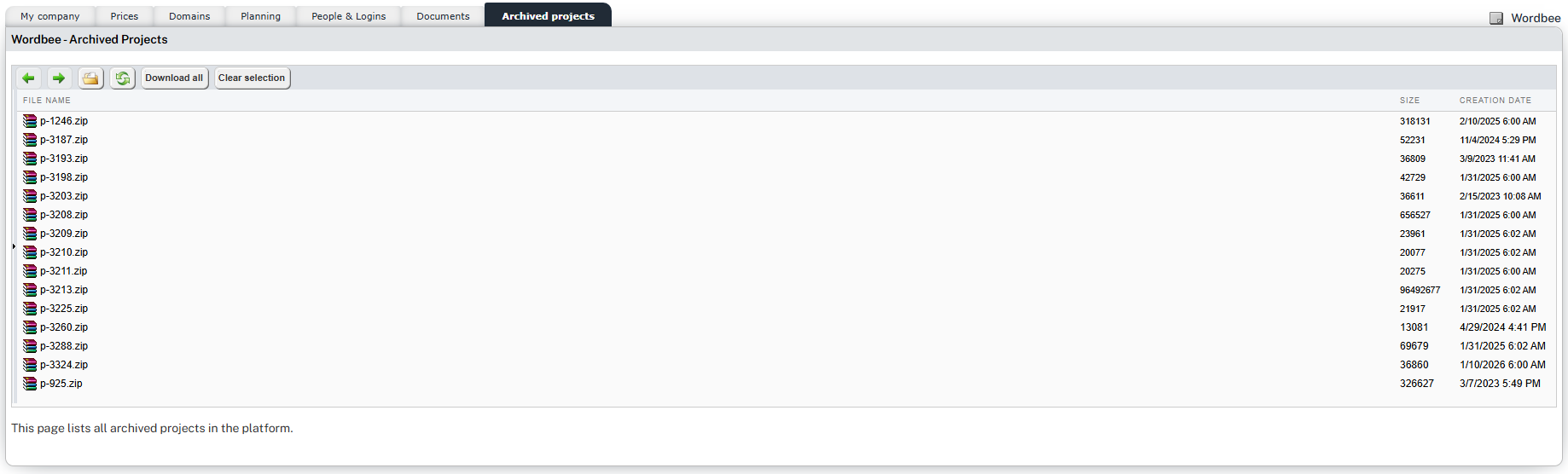
Zip files of deleted projects are available for at least 30 days after the deletion. After that, the weekly clean-up can remove them.
Administrators who want to collect these zip files automatically can use the Wordbee Translator API (see Learn More).
Benefits of project archiving
Archiving, offloading and data retention help you with:
-
Storage space: keep your platform's storage under control. You can restore offloaded projects when you need them, and buy more storage if required.
-
Performance: less online data keeps the platform fast for daily work.
-
Organized project lists: archiving old projects keeps your project list up to date.
-
Transparency and compliance: meet data retention policies and ISO standards. Archived data supports accountability for decisions made during a project.
-
Business analytics: essential data stays online, so the business analytics module can report on it over the long term.
-
Training and reference: archived projects serve as reference material for training and for new projects.
Learn More
-
Project Management: manage projects, including status changes and workflows.
-
Consolidation of Project Memories to Master: keep a project's translations in a master memory before offloading it.
-
Workflow template (Automation options for orders): automate what happens to orders once they are completed.
-
Download the zip file of a deleted project (API): download the zip files of deleted projects through the Wordbee Translator API.