
The Memory Finder panel shows matching translations from your translation memories for the segment you are working on, so you can reuse them without leaving the grid.
Viewing Memory Matches
Open the Memory Finder from Panels > Memory finder, or press Ctrl+Alt+K. As you move between segments, the panel lists the matches from your translation memories, ranked by match percentage.
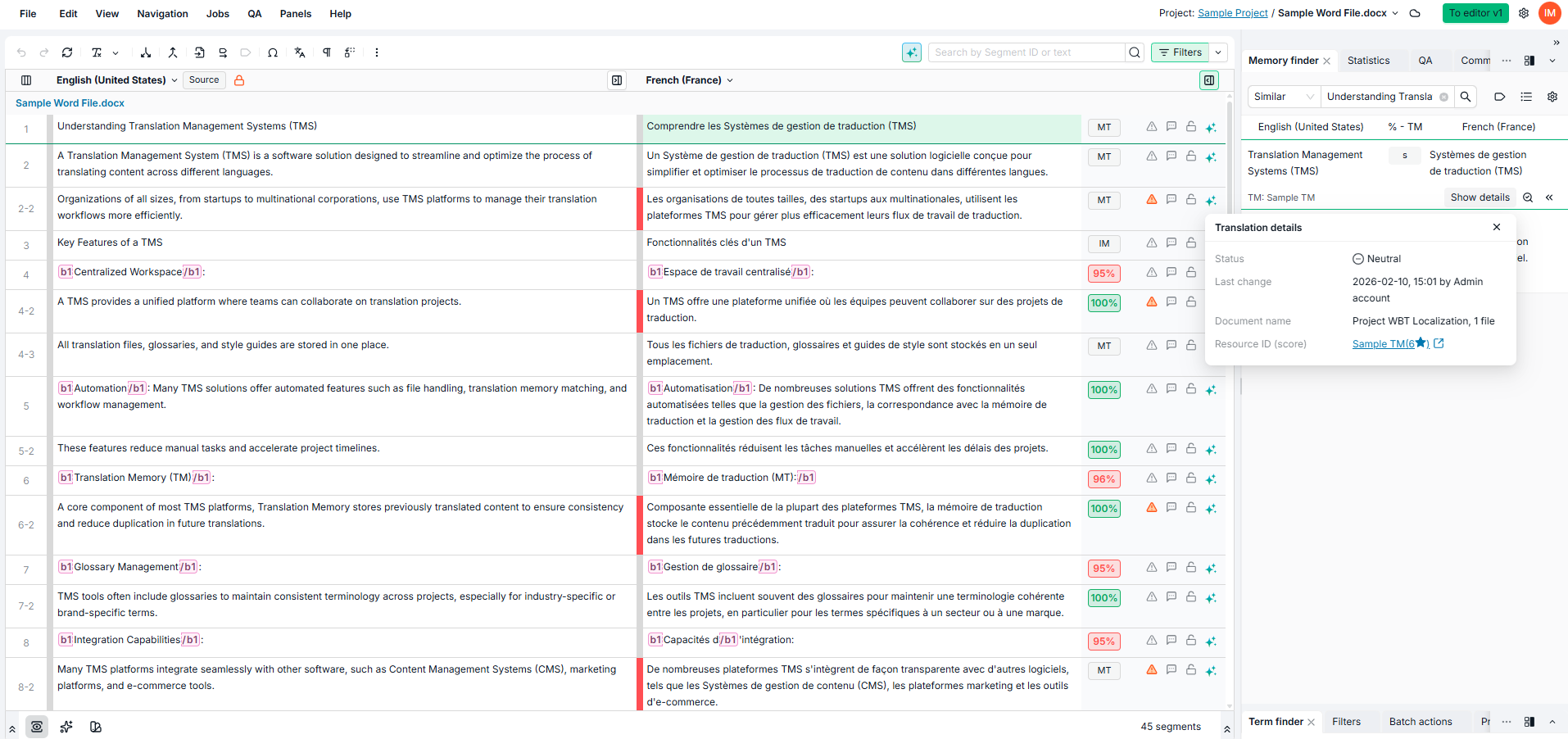
Understanding Match Indicators
|
Indicator |
Meaning |
|---|---|
|
Percentage |
How closely the memory source matches your segment. 100% is an exact match. |
|
PM or TM tag |
The hit comes from a project memory or a translation memory. Hover to see its name and rating. |
|
s tag |
The hit is a suggestion. |
|
Warning triangle |
The hit is unreliable, or a penalty applies. Hover to see which. |
|
Track changes |
Differences from your segment: added text in blue, deleted text struck through in red. |
Viewing a Hit's Details and Context
Select a hit to show its actions:
-
Show details: the hit's status, when and by whom it was created or last changed, the document name, labels, and Resource ID (score). Click the memory name to open the memory in a new tab.
-
Preview hit's context: the hit with the two segments before and after it in the original document.
The author's name and the link to the memory are shown only if your access rights allow it.
Inserting Translations
Select a hit and click Insert text. The match replaces the target text.
To browse and insert hits from the keyboard, use the Previous memory hit, Next memory hit, and Insert memory hit shortcuts. They have no default keys: assign them in Preferences > Shortcuts.
Searching Manually
To search for specific text, click the search field, type your query, and press Enter. Choose Source or Target below the field to search that language. To return to the automatic results, click a segment in the grid.
Choosing How Your Query Is Matched
Click the mode picker on the left of the search field. Your choice is remembered in your browser.
|
Mode |
What it matches |
Tips |
|---|---|---|
|
Similar (default) |
Segments containing the words you type, in any order; partial and approximate matches are included. |
To find an exact word or phrase, put quotation marks around it, for example "constitution". This finds the word itself and not longer words that contain it, such as "reconstitution", for that search only. Straight ("…") and curly (“…”) quotation marks both work. |
|
Contains |
Segments where the words you type appear in the same order; may be part of a longer segment or the whole segment. |
As in Similar, put quotation marks around a word or phrase to find it exactly. |
|
Whole segment |
Segments whose entire text matches what you typed, with nothing before or after. |
|
|
Wildcards |
Segments matching a wildcard pattern: ? for any single character, * for any sequence. |
Type release note* to match both "release note" and "release notes". |
|
Regex |
Segments matching a regular expression, matched anywhere in the segment. |
Matching is case-insensitive and finds the pattern anywhere in the segment. \b, \d, \s, \w, and look-ahead and look-behind are not supported. |
In Chinese, Japanese, and Thai, which do not separate words with spaces, a quoted search finds the text as typed, also inside longer words.
The text you searched is highlighted in the results in Similar and Contains mode.
Regional Language Variants
Searches also find content stored under a regional variant of your job's language, for example English (United States) in an English job. If a memory is set to Strict - Do not leverage across language variants in its search settings, only the exact language is searched.
Choosing Memories and Hit Types
Click the Resources button (list icon) in the panel header. It has two tabs:
-
Resources: select the memories to search. All are selected by default.
-
Hit type: show or hide Phrase matches, Suggestions, and Concordances, and drag them to change their order in the list.
Your choices are remembered.
Settings
Click the gear icon in the panel header. Restore defaults resets all settings.
|
Setting |
What it does |
|---|---|
|
Min. % match threshold |
The lowest match percentage shown (80% by default). |
|
Include unreliable results (MT, fuzzy, and red-status) |
Also shows machine translations, fuzzy pretranslations, and red-status entries, marked with a warning triangle (off by default). |
|
Show/hide tags |
Shows or hides formatting tags in the results. |
|
Show differences between grid and hit segments with track-changes |
Marks what differs between your segment and the hit. |
|
Highlight partial matches |
Highlights the text that matches your segment. |
|
Show resource name |
Shows the memory name under each hit. |
|
Auto-fill source if no appropriate match is found |
Copies the source into an empty target when there is no suitable match. |
|
Auto-fill with top 100% match |
Inserts the best 100% match into an empty target. |
|
Remove tags upon insert |
Removes formatting tags when you insert a hit. |
Example Scenarios
|
Use Case |
How To |
|---|---|
|
Reuse an exact translation |
Select the 100% match and click Insert text, or turn on Auto-fill with top 100% match. |
|
Review and insert hits from the keyboard |
Assign keys to Previous memory hit, Next memory hit, and Insert memory hit in Preferences > Shortcuts. |
|
Find a translation the automatic results do not show |
Type the text in the search field and press Enter. |
|
Find an exact word, not longer words that contain it |
Put quotation marks around it, for example "constitution". |
|
See only reliable, high-quality matches |
Raise Min. % match threshold. Unreliable results are already hidden while Include unreliable results is off, which is the default. |
|
Search one memory only |
In Resources, clear the other memories. |
Learn More
-
Term Finder Panel: Look up terminology from your termbases while you translate.
-
Adding Terms and Segments While Translating: Add a segment to a memory from inside a job.
-
Filters Panel: Narrow down which segments appear in the grid.